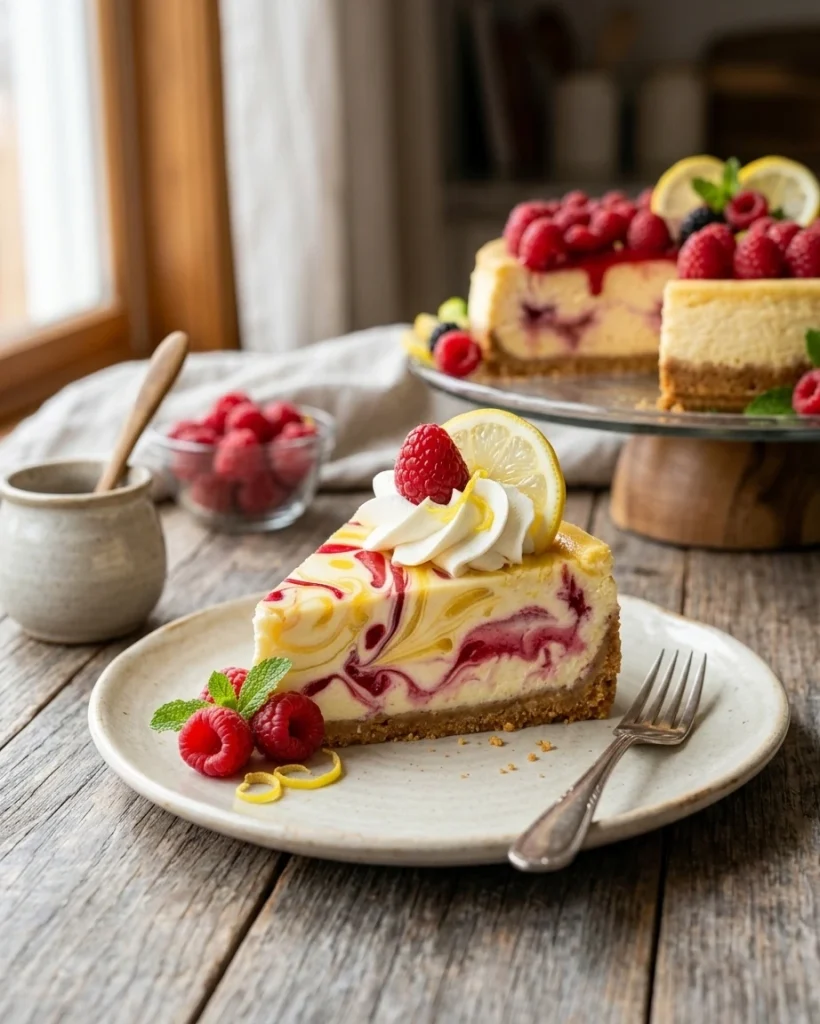
Bright, creamy, and vibrantly balanced, a restaurant-worthy dessert relies on the delicate interplay of rich dairy and lively fruit acidity. Recreating the Gordon Ramsay Best Lemon Raspberry Cheesecake Recipe brings Michelin-level patisserie balance straight to your home kitchen. Built on a crisp, buttery digestive biscuit crust, this elegant dessert features a velvety cream cheese base brightened with fresh lemon zest and juice, then marbled with a ribbon of tangy raspberry coulis. With reliable techniques for gentle baking and controlled cooling, you can bake a bakery-level centerpiece that turns out smooth, creamy, and completely crack-free.
Why You’ll Love This Recipe
- Harmonious Citrus & Berry Balance: Zesty lemon curd notes embedded in the batter offset the natural richness of the cream cheese, while sweet-tart raspberry swirls deliver refreshing contrast.
- Silky, Crack-Free Crumb: Gentle low-temperature baking paired with an oven-door resting method eliminates thermal shock and keeps the top flat and pristine.
- Toasted, Buttery Biscuit Base: Par-baking the crushed biscuit crust ensures a crunchy, firm structure that never turns soggy under the wet filling.
- Dinner Party Showstopper: With its bright marbled surface, this stunning dessert can be prepared a full day in advance, giving you effortless entertaining results.
Chef’s Secrets for Silky Texture and Crisp Crusting
Baking a smooth, dense cheesecake requires close attention to temperature management and gentle emulsification:
- Bring Dairy Completely to Room Temperature: Cold block cream cheese will not blend evenly, leaving stubborn white specks throughout the batter. Take the cheese, eggs, and sour cream out of the refrigerator 1 to 2 hours before starting.
- Reduce the Raspberry Puree: Simmering the coulis down until thickened drives off excess water that would otherwise weep into the cheesecake and create soggy pockets.
- Strain Away Seeds: For a refined mouthfeel, always press the warm raspberry reduction through a fine-mesh sieve with the back of a spoon to remove gritty seeds.
- Mix on Low Speed: High-speed beating whips air into the batter. That air expands when heated, forcing the cake to soufflé up in the oven, only to collapse and crack as it cools. Keep mixer speeds low throughout.
Gordon Ramsay Best Lemon Raspberry Cheesecake Recipe
Follow these precise steps to prepare an artisan baked lemon cheesecake finished with an elegant swirl of seedless raspberry coulis.
Ingredients
For the Biscuit Crust:- 7 oz (200g) digestive biscuits or graham crackers, finely crushed
- 5 tablespoons (75g) unsalted butter, melted
- 1 tablespoon granulated sugar
- 1 pinch fine sea salt
- 6 oz (170g) fresh or frozen raspberries
- 2 tablespoons granulated sugar
- 1 teaspoon freshly squeezed lemon juice
- 1/2 teaspoon cornstarch whisked into 1 teaspoon cold water
- 24 oz (680g / 3 standard 8-oz blocks) full-fat cream cheese, softened to room temperature
- 1 cup (200g) superfine granulated sugar
- 3 large eggs, room temperature
- 1 large egg yolk, room temperature
- 1/2 cup (120ml) sour cream or crème fraîche, room temperature
- 1/3 cup (80ml) heavy whipping cream, room temperature
- 2 teaspoons finely grated fresh lemon zest (from 2 unwaxed lemons)
- 2 tablespoons freshly squeezed lemon juice
- 1 1/2 teaspoons pure vanilla extract or vanilla bean paste
- 1 1/2 tablespoons all-purpose flour, sifted
- Fresh raspberries
- Thin twists of fresh lemon peel
- Fresh mint sprigs
- Powdered sugar for dusting
Instructions
- Prepare the Pan and Oven: Preheat your oven to 325°F (165°C). Lightly grease the interior of a 9-inch (23cm) springform pan with butter and line the bottom with a circle of parchment paper.
- Make and Bake the Crust: In a medium bowl, combine the crushed biscuit crumbs, melted butter, sugar, and salt. Stir until the mixture resembles damp sand. Press the crumbs firmly into an even layer over the bottom and slightly up the edges of the pan using the flat bottom of a drinking glass. Bake for 10 minutes until lightly golden and aromatic. Remove and allow to cool on a wire rack while making the filling.
- Prepare the Raspberry Swirl: In a small saucepan, combine raspberries, 2 tablespoons sugar, and 1 teaspoon lemon juice over medium heat. Simmer for 4 to 5 minutes, breaking the berries apart with a wooden spoon. Stir in the cornstarch slurry and simmer for 1 minute until thickened and glossy. Press the hot puree through a fine-mesh sieve into a bowl to discard the seeds. Set aside to cool to room temperature.
- Cream the Cheese and Sugar: In a large mixing bowl or stand mixer fitted with the paddle attachment, beat the softened cream cheese and 1 cup of sugar on low speed for 2 to 3 minutes until completely smooth, scraping down the bowl with a spatula to ensure no lumps remain.
- Add Aromatics and Dairy: Sift the flour into the bowl. Add the sour cream, heavy cream, lemon zest, lemon juice, and vanilla. Mix on low speed for 1 minute until satiny and completely integrated.
- Gently Incorporate Eggs: Add the eggs and egg yolk one at a time, mixing on low speed just until each yolk is incorporated before adding the next. Do not whip air into the batter. Tap the bowl against the countertop a few times to release any trapped air bubbles.
- Assemble and Marbelize: Pour the lemon cheesecake batter over the cooled crust and smooth the surface with an offset spatula. Dot tablespoons of the cooled raspberry puree over the surface. Use the tip of a paring knife or a wooden skewer to draw figure-eight motions through the drops, creating a marbled ribbon pattern.
- Bake to a Soft Wobble: Place the springform pan on a baking sheet on the center oven rack. Bake at 325°F (165°C) for 50 to 55 minutes. The outer 2 inches should be set and lightly puffed, while the center 2 to 3 inches should still display a soft, gentle wobble when the pan is gently shaken.
- Phase-Cool in the Oven: Turn off the oven. Prop the oven door open 1 inch with the handle of a wooden spoon and leave the cheesecake inside undisturbed for 1 hour. This gradual cooldown relieves tension on the surface and stops cracks from forming.
- Chill and Set: Remove the cheesecake from the oven. Run a thin, flexible palette knife carefully around the inside rim of the pan to free the edges as it contracts. Cool to room temperature on a wire rack for 1 hour, then cover loosely and refrigerate for at least 4 hours, or preferably overnight.
- Unmold and Serve: Unlatch and remove the springform collar. Slice with a long, thin chef’s knife dipped into warm water and wiped clean between each cut for pristine edges. Garnish with fresh raspberries, lemon twists, and fresh mint.
How to Know When It Is Done
Cheesecakes finish cooking through carryover heat; baking until the entire surface is rigid will dry out the batter and ruin its creamy consistency:
- The Wobble Test: Tap the side of the baking pan with an oven mitt. The edges should appear firm, matte, and slightly elevated, while the center 2 to 3 inches should gently tremble like set gelatin.
- Surface Appearance: The raw wet gloss will change to a soft satin finish across the top without excessive browning.
- Avoid Knife Tests: Do not insert a knife or toothpick into the center. Breaking the surface integrity creates an instant weak point that tears into a wide split as the cake cools.
Common Mistakes to Avoid
- Using Cold Ingredients: Chilled cream cheese resists blending and creates small lumps that cannot be smoothed out without overbeating the mixture.
- Whipping on High Speed: Excessive beating introduces air bubbles that expand during baking and collapse upon cooling, causing noticeable fissures.
- Skipping Puree Straining: Leaving seeds in the raspberry coulis introduces gritty bits that detract from the dessert’s velvety texture.
- Subjecting to Thermal Shock: Transferring a piping-hot cheesecake straight from the oven into the cold refrigerator causes dramatic contraction and surface tearing. Always use the phased-cooling method.
Serving Suggestions
This citrus-berry combination makes a light, palate-cleansing finish for rich meals:
- Fresh Berry Medley: Serve each slice accompanied by fresh raspberries, blackberries, or macerated strawberries tossed in a teaspoon of lemon juice.
- Warm Beverages: Pairs naturally with a double shot of espresso, a hot flat white, or fragrant Earl Grey tea.
- Dessert Wine: Complement the lemon-citrus notes with a chilled glass of Limoncello, late-harvest Riesling, or sparkling Prosecco.
Storage and Freezing Instructions
Refrigeration: Keep leftover cheesecake covered in an airtight container or under a cake dome in the refrigerator for up to 5 days. Keep it protected from strong refrigerator odors.
Freezing: Once fully chilled and set, the cheesecake can be frozen whole or in pre-cut slices. Wrap tightly in a double layer of plastic wrap followed by heavy-duty aluminum foil. Freeze for up to 2 months. Thaw slowly overnight in the refrigerator before serving.
Frequently Asked Questions
Do I need a water bath for this cheesecake?
No water bath is required. Gentle 325°F baking, the inclusion of sour cream and a small amount of flour for structural stability, and the 1-hour rest inside the turned-off oven yield a rich, crack-free texture without the fuss of water baths.
Can I use bottled lemon juice?
Freshly squeezed lemon juice is strongly recommended. Bottled lemon juices contain chemical preservatives that impart an artificial, bitter tang. Fresh lemons also yield aromatic oils from their zest that give this cheesecake its distinctive fragrance.
Can I use frozen raspberries for the swirl?
Yes. Frozen raspberries work well. Simmer them with the sugar and lemon juice as directed, ensuring the mixture is reduced until thickened so excess water does not dilute the cheesecake filling.